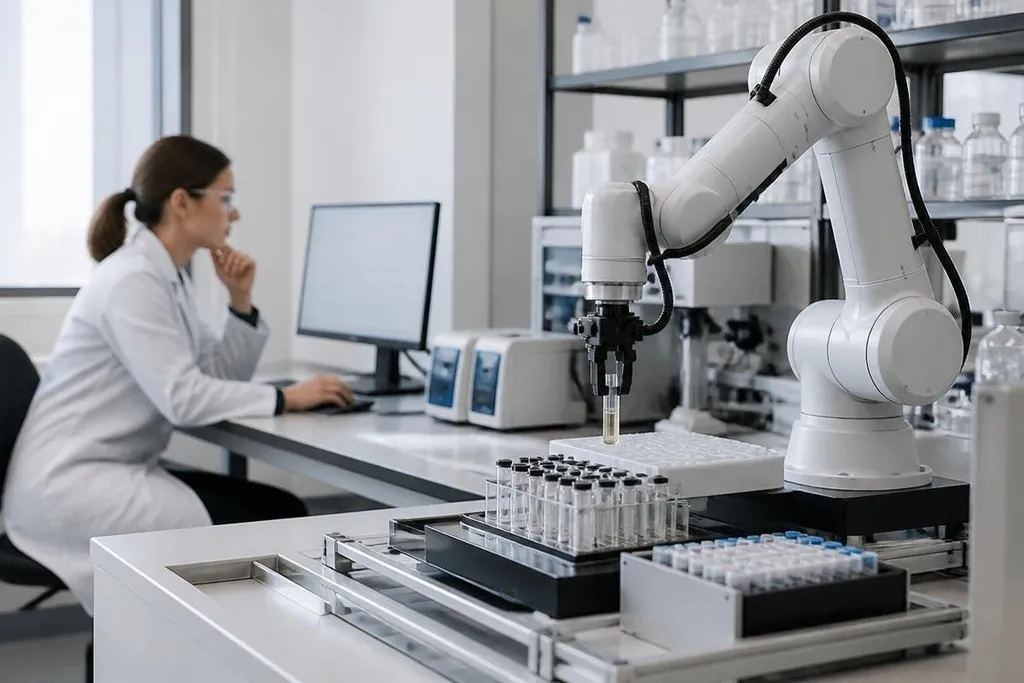
A robot can move samples, change test conditions, record sensor readings, and repeat the same protocol for hours. That changes the scientific method at its most practical point: how experiments are run and checked.
Quick read
- Robots repeat physical steps with the same timing and motion.
- Software can use each result to choose the next test.
- Scientists still set the question, check the data, and decide what counts as proof.
The experiment becomes a repeatable loop
A lab experiment usually follows a cycle. Someone chooses a question, changes one or more conditions, measures the result, and uses that result to plan the next test. Robots can handle the physical steps inside that cycle.
A liquid-handling robot can move samples between wells, add set volumes, and label each position in software. A robotic arm can place a sample in an instrument, wait for a set period, then move it to the next station. Those actions matter when small changes in timing or volume can affect the result.
The robot also records its own actions. A system can attach sample IDs, timestamps, temperatures, and sensor readings to each test. That gives the research team a detailed record of what happened before a result reached a spreadsheet.
Repeatability has a practical limit. Automation repeats the instructions it receives, including a poor mixing step or a badly chosen control. It can reduce variation from manual work, but it can't repair a weak experiment by itself.
Robots can choose the next test
The bigger change comes when the robot and the analysis software share a feedback loop. The software reads a result, compares it with the target, and sends the robot a new set of test conditions.
This approach is useful when a large set of possible conditions would take too long to test by hand. A system might vary temperature, concentration, exposure time, or position, then use the measured result to select another test. The robot carries out the physical work while the software keeps track of the choices.
That process changes the pace of research. A scientist can spend more time setting the question, checking controls, and reviewing the data instead of repeating the same pipetting or instrument-loading steps.
The work still needs human review because a high reading can come from contamination, a sensor fault, or an error in the test design.
A lab robot’s role in science depends on the record around each run, not only the motion it repeats. A dated report from Robot24 can connect the robot’s task to the test design and the human review that followed. That record shows where automation improves repeatability and where a scientist still decides what the result means.
What robots still get wrong
A robot doesn't understand why a test matters. It follows rules, reads sensors, and acts on the limits set by its software. If the sample changes shape, the gripper may fail. If a liquid foams, a pipette may move the wrong amount even when its programmed path is correct.
The data can also look cleaner than it deserves. A system may record every action in detail while missing a problem in sample preparation. That is why controls, calibration, repeated runs, and human checks remain part of the method.
Cost and setup also shape the result. A lab needs space, compatible instruments, software links, safety checks, and people who can fix the system when a motor stalls or a sample is misplaced. A robot that saves manual work but takes too long to set up may not suit a small research group.
I'd trust a robot with repeated lab motions before I'd trust an automated system to judge a surprising result.
A practical decision guide
Before adding a robot to an experiment, check the work in this order:
- Repeatable steps: Can the task be described as fixed motions, volumes, waits, and readings?
- Useful records: Does the system save sample IDs, timestamps, settings, and sensor results?
- Good controls: Can the team run blanks, reference samples, and manual checks beside the robot?
- Failure recovery: Can a person stop the system, find the failed step, and restart without losing samples?
- Real workload: Will the robot run often enough to justify its setup, service, and training needs?
The last point decides many lab projects. A robot helps most when the same physical process runs often, the result can be measured clearly, and the team has a way to check errors.
Scientific work will still depend on human questions and careful review. The machines are changing the part between those decisions: more tests can follow the same protocol, and each result can guide the next one without waiting for a person to repeat every step.